-
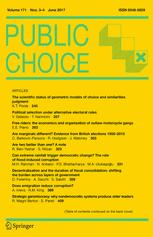
2. Political selection under alternative electoral rules
Pages 257-281
4. Are marginals different? Evidence from British elections 1950–2015
Pages 303-321
6. Can extreme rainfall trigger democratic change? The role of flood-induced corruption
Pages 331-358
7. Decentralization and the duration of fiscal consolidation: shifting the burden across layers of government
Pages 359-387
8. Does emigration reduce corruption?
Pages 389-408
Book Review
10. Cass R. Sunstein: The ethics of influence: government in the age of behavioral science
Pages 429-432
LiberAcción 2017 – Conversación sobre la empresarialidad
Reason Papers. A Journal of Interdisciplinary Normative Studies, Volume 38, no. 2 (Winter 2016),
Editorial —Carrie-Ann Biondi and Shawn Klein
Symposium: Andrew Jason Cohen’s Toleration
Comments on Andrew Jason Cohen’s Toleration
—Emily M. Crookston – 8 Comments on Andrew Jason Cohen’s Toleration —David Kelley
Response to Emily M. Crookston and David Kelley
—Andrew Jason Cohen
Articles
Freedom: Positive, Negative, Expressive —Danny Frederick 39 Memorializing Genocide I: Earlier Holocaust Documentaries
—Gary James Jason
Review Essays
The U.S. Founding: Washington’s Allies and Opponents: Review Essay of John Ferling’s Jefferson and Hamilton, Stephen Knott and Tony Williams’s Washington and Hamilton, Thomas Fleming’s The Great Divide, and Carson Holloway’s Hamilton versus Jefferson in the Washington Administration
—Richard M. Salsman 89 Review Essay: The Politics of Defeat: A Tribute to Sadik al-Azm’s Self-
Criticism after the Defeat —Kanan Makiya 100 Review Essay: Timur Kuran’s The Long Divergence: How Islamic Law Held Back the Middle East —Salim Rashid 117
Acceda aquí al ejemplar en pdf completo.
History of Political Economy, Volume 49, Number 1, March 2017
Articles
Gold, the Brains Trust, and Roosevelt
The (Rail)Road to Lochner: Reproduction Cost and the Gilded Age Controversy over Rate Regulation
Musgrave, Samuelson, and the Crystallization of the Standard Rationale for Public Good
and A Previously Unpublished Correspondence between Adam Smith and Joseph Nicolas de Windischgrät
and Is Food Self-Sufficiency Conducive to Long-Term Growth? An Assessment of Malthus (1803) on the International Corn Trade
Danilo Freitas Ramalho da Silva – Lucas’s Research in the Late 1960s and the Natural Rate of Unemployment
Book Review
Léon Walras, Elements of Theoretical Economics or the Theory of Social Wealth
PARADOJAS DEL EMPRESARIADO – Por Alberto Benegas Lynch (h)
Al ingenio del empresario le debemos los alimentos, los medicamentos, los transportes aéreos, marítimos y terrestres, las computadores, los progresos en la cibernética, las comunicaciones, los libros, el teatro, los diques y represas, las tiendas, los comercios, la vestimenta, la refrigeración, los muebles, la edificación y prácticamente todo los que nos rodea.

El empresariado que tiene éxito es en los hechos un benefactor de la humanidad auque sus operaciones no tienen el móvil de la beneficencia sino de incrementar su patrimonio, pero para lo cual, en un mercado libre, está obligado a servir a sus semejantes. Se destaca por tener un olfato y el sentido de la oportunidad al efecto de sacar partida del arbitraje, es decir, para detectar cuando los costos están subvaluados en términos de los precios finales.
Sin embargo ese mismo personaje cuando se alía con el poder produce desastres monumentales. Al recibir privilegios a través de mercados cautivos no solo explota miserablemente a su prójimo sino que termina entregando su empresa a las fauces del Leviatán.
LIBERTAS: SEGUNDA ÉPOCA, 2017 | Volumen 2, Número 1
El Método Científico en la Teoría Económica de A. A. Cournot
María Blanco
pp. 3-23
Emprendores, República y Democracia
Alejandro Gómez
pp. 25-44
Incidencia y Efectos de los Impuestos
Gustavo Hasperué
pp. 45-65
Economic and Philosophical Implications of Hayek’s Knowledge Problem
Nicolás Cachanosky & Alexandre Padilla
pp. 67-79
The Final Nail in the Cross of Gold
Ryan H. Murphy & Eric L. Li
pp. 81-89
RIIM 62-63 (Mayo-Octubre 2015)
- Repensando la macroeconomía del capital Adrián O. Ravier
- El impacto del mercantilismo español en el Río de la Plata: el caso de los cueros (1790 – 1825) Lionel Alberto Barbagallo
- ¿Es posible una teoría austríaca de la democracia? Eduardo Fernández Luiña
La aritmética electoralista del Banco Central Federico Ferrelli Mazza
- Tres modelos contemporáneos de ciudadanía Alejandra M. Salinas
- Una lectura de teoría social y política en Smith, Downs y Nino Teresa De Stefano
- El Estado Islámico hoy Juan Manuel Quirós Canciller
- Selección de textos de Juan Hipólito Vieytes Carlos Newland
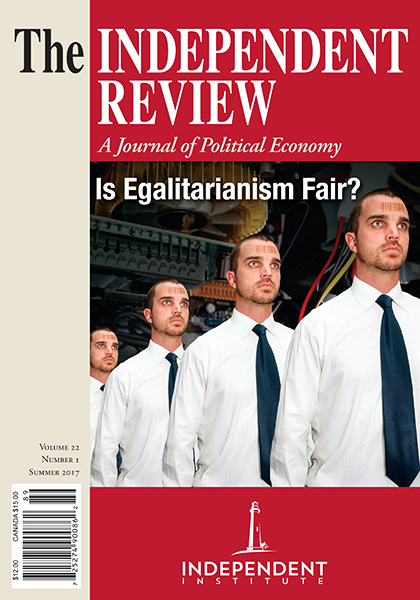
The Independent Review, Summer 2017, Volume 22, Number 1
| Articles | |
| New Thinking on Egalitarianism By Robert M. Whaples From Equality and the Rule of Law to the Collapse of Egalitarianism
SUMMARY By Ryan M. Yonk James R. Harrigan The Limits of Redistribution and the Impossibility of Egalitarian Ends
SUMMARY By Jeremy Jackson Jeffrey Palm We’ll Never Be Royals, but That Doesn’t Matter
SUMMARY By William Arthur Carden Sarah Estelle Anne Bradley Flat Is Fair: American Public Opinion on Taxes and the Myth of Egalitarianism
SUMMARY By Brian J. Gaines Incentives and Expectations: Community Relations and Recovery in Tamil Nadu after the Indian Ocean Tsunami Robert D. Tollison: In Memoriam |
|
Book Reviews |
|
 C.S. Lewis on Politics and the Natural Law C.S. Lewis on Politics and the Natural LawBy Justin Buckley Dyer and Micah J. Watson Reviewed by John Robinson
|
|
| Etceteras | |
| Moderation in Response to Provocation Is No Vice By Robert Higgs |
|
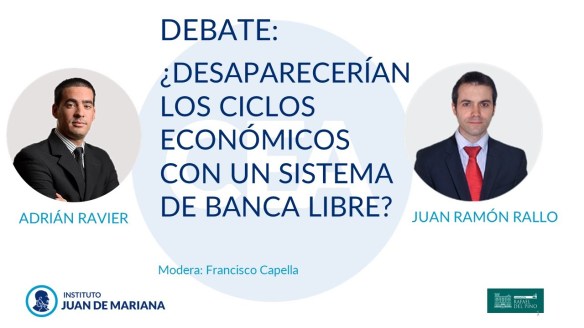
Comentario al debate de Adrián Ravier y Juan Ramón Rallo – ¿Desaparecerían los ciclos económicos con un sistema de banca libre?
Algunas cosas que me han resultado interesantes:
1. Lo de «necesariamente» versus «puede ser» tiene un problema epistemológico. Todas las deducciones de las leyes económicas son un «puede ser» a partir del supuesto de aprendizaje en un mercado libre, que no es ontológicamente necesario pero sí humanamente plausible.
2. A partir de ese supuesto es que se infiere que los mercados libres tienden a una mayor coordinación del conocimiento disperso.
3. Por ende respondiendo a la pregunta de Paco, why not esa inferencia rige para los bancos en un sistema de banca libre.
4. Porque la argumentación de Mises en Human Action, citada por Adrián, no afirma -como sugirió Rallo- que los banqueros van a tener un conocimiento económico a priori por el cual van a tender o no a cartelizarse. Pueden intentar hacerlo, pero como no hay garantía estatal de depòsitos, ante la gran corrida que ello va a generar van a «aprender» a no hacerlo.
5. Si a ello lo llamamos ciclo o fluctuación es una cuestión semántica. La cuestión es que en un mercado libre bancario habría una tendencia a NO emitir indiscriminadamente precisamente porque hay un incentivo a no quebrar, ni solos ni juntos. El mismo Mises se afirma que en un mundo donde el estado no hubiera intervenido, el aprendizaje de la banca libre se hubiera visto evolutivamente.
Acceda aquí al video del debate.
The Review of Austrian Economics, June 2017, Issue 2, Pages 153-261
-
1. Malinvestment
Pages 153-167
2. The view from Vienna: An analysis of the renewed interest in the Mises-Hayek theory of the business cycle
Pages 169-192
3. The perils of privacy regulation
Pages 193-214
5. The rise and fall of the subsistence fund as a resource constraint in Austrian business cycle theory
Pages 235-249
 Punto de Vista Economico