Archivo del Autor: Adrián Ravier
Rationality, Markets and Morals Studies at the Intersection of Philosophy and Economics (RMM), Volume 6, 2015
|
||||||||||
|
||||||||||
|
||||||||||
|
||||||||||
| Acceda aquí al ejemplar completo. |
¿Otra Burbuja en Proceso? – por Alvaro Vargas Llosa
El riesgo moral, el dinero fácil y el crédito barato nunca han producido buenos resultados.
La historia está llena de ejemplos de desastres financieros provocados por la manipulación monetaria que se origina en los bancos centrales y luego se expande a otras partes del sistema. Uno podría pensar que la crisis financiera de 2007/8, cuyos efectos no han desaparecido del todo, enseñaría algo a los políticos, los banqueros centrales, las corporaciones, y los consumidores sobre las causas de la contracción de créditos y debacles.
Piénselo nuevamente. Los cuatro bancos centrales más grandes del mundo han inyectado más de $9 billones de dólares en el sistema desde la última crisis financiera y han provocado un mundo de tasas de interés absurdamente bajas e incluso negativas. Los incentivos generados por estas políticas y sus efectos -el riesgo moral, el dinero fácil y el crédito barato- conducirán, en algún momento, al estallido de nuevas burbujas.
¿Cuáles? Nunca es fácil decirlo, pero Estados Unidos ha visto un crecimiento poco saludable del crédito subprime, y del crédito en general, en tres mercados: tarjetas de crédito, créditos vehiculares y créditos estudiantiles. No sería una sorpresa si alguno de estos provoca la siguiente contracción crediticia.
La deuda total de tarjetas de crédito superó la marca de $1 billón por primera vez desde 2009, los préstamos estudiantiles ascienden ahora a un total de $1,4 billones y los créditos vehiculares no están lejos de $1,2 billones- una cantidad que empequeñece el pico anterior a la crisis financiera.
En los últimos cinco años, las empresas estadounidenses han emitido más de $7 billones de nueva deuda, mostrando que los incentivos creados por estas tasas de interés perversamente bajas van más allá de los mercados mencionados anteriormente.
Sin embargo, esos mercados de crédito de consumo son los que ya muestran señales de angustia, por lo que es mejor prestar cierta atención. Capital One, gran financista de prestatarios subprime (particularmente a través de tarjetas de crédito y créditos vehiculares), recientemente ha tenido que declarar en perdida una gran cantidad de deuda, por un total de más del 5% de sus préstamos pendientes, tal nivel es usualmente considerado el umbral de un territorio muy peligroso.
El sector de créditos vehiculares es especialmente alarmante. Las ventas de automóviles se duplicaron en los últimos siete años y ahora están en un nivel sin precedentes. Como sucedió con los préstamos hipotecarios antes de la hecatombe 2007/8, el dinero se lanzó en forma de créditos vehiculares sin inicial y con períodos prolongados. Como era de esperar la industria está experimentando ahora los incumplimientos (la morosidad está en el punto más alto desde 2009). El resultado es el aumento fuerte de la oferta de vehículos usados que ha traído abajo sus precios. Una gran parte de la industria automotriz, incluidos los fabricantes que hacen prestamos a clientes y empresas de alquiler, dependen de la venta de valores que se respalda en los autos usados para financiar sus operaciones. Las empresas de alquiler también dependen de la venta de automóviles usados para comprar otros nuevos.
Estos síntomas apuntan a riesgos no disímiles en naturaleza a lo que estaba sucediendo antes de la debacle financiera de las hipotecas. Los bancos están comenzando a reducir los créditos corporativos por primera vez desde esa crisis-el total de préstamos en los quince mayores bancos estadounidenses regionales en el primer trimestre de 2017 fue de $ 10 mil millones por debajo del trimestre anterior, un revés muy considerable en la tendencia.
Standard and Poor’s rebajó su calificación de riesgo a 1,088 compañías en los Estados Unidos el año pasado, y los analistas están pronosticando una ola de incumplimientos de créditos basura, tal vez abarcando una de cada cuatro compañías emisoras de deuda de alto rendimiento.
Uno nunca puede decir exactamente cuándo estallará una burbuja o qué rincón del sistema financiero será el epicentro del terremoto. Pero siempre y cuando estas inminentes burbujas exploten, la culpa mayor será de las políticas irresponsables que supuestamente evitarían las burbujas futuras y que crearon la tormenta perfecta de riesgo moral, dinero fácil y crédito barato una vez más.
___________________
Alvaro Vargas Llosa es Senior Fellow de The Center on Global Prosperity en el Independent Institute. Ha sido columnista del Washington Post Writers Group y su libro, Liberty for Latin America, ha recibido el Premio Sir Antony Fisher International Memorial por sus contribución a la causa de la Libertad en 2006.
Traducción: Fabrizzio Garmendia y Edwar E. Escalante son asociados del think tank Andes Libres en Peru. La version original del articulo se encuentra en el Independent Institute
NPPE—New Perspectives on Political Economy
Pierre Desrochers, Vincent Geloso: Snatching the Wrong Conclusions from the Jaws of Defeat: Part 1 – The Missing History of Thought: Depletionism vs Resourceship
Pierre Desrochers, Vincent Geloso: Snatching the Wrong Conclusions from the Jaws of Defeat: Part 2 – The Wager: Protagonists and Lessons
Nikolai G. Wenzel: Classical Communitarianism and Liberal Anomie: Toward an Individual yet Robust Theory of Citizenship
Youliy Ninov: A Free Market Alternative to Anarcho-Capitalism
ARTHUR KOESTLER: UNA VIDA INTENSA – Por Alberto Benegas Lynch (h)
El subtítulo de uno de los libros de Fernando Savater reza se este modo: “sobre el gozo de leer y el riesgo de pensar”. Magnífico resumen de la parte más sustanciosa de la vida a la que no todos le sacan debido provecho. Como escribía Gothe “al leer uno no solo se informa sino, sobre todo, se transforma”. La lectura tiene la gran virtud de ejercitar la imaginación y, por ende, estimula el espíritu creativo, a diferencia, por ejemplo, de las incursiones televisivas que imponen el ritmo y dan servida la imagen. La lectura de obras de peso conducen al buen pensamiento, a lo que algunos le escapan o por desidia o por miedo al cambio que suele hacer crujir por dentro al lector.
En todo caso, en esta nota periodística me voy a referir a un personaje suculento que era un gran lector y, por tanto, de un gran pensador: Arthur Koesler, como se sabe, a su vez un gran escritor: su Autobiografía en dos tomos, sus célebres colecciones de ensayos, especialmente En busca de lo absoluto (que contiene la muy meditada crítica a Ghandi, sus reflexiones sobre el materialismo, el concepto de la teoría, entre otros), The Art of Creation (sobre la risa, el proceso de descubrimiento, aprender a pensar, la evolución de las ideas, las emociones y otros temas relevantes) y sus muy difundidas novelas El cero y el infinito y Darkness at Noon , las dos severas reprimendas al comunismo del cual él formó parte y abandonó espantado por las horrendas crueldades del sistema. En realidad hay quienes opinan que no son estrictamente novelas sino más bien ensayos de denuncia, como Koestler mismo confiesa en su antes referida autobiografía: “Arruiné la mayor parte de mis novelas por mi manía de defender en ellas una causa; sabía que un artista no debe exhortar ni pronunciar sermones pero seguía exhortando y pronunciando sermones”.

Apunto aquí una digresión respecto a esta última cita de Koestler cuya conclusión, si bien la más difundida entre los escritores, no es compartida por todas las grandes plumas. Menciono tres ejemplos. T.S. Elliot se pregunta “¿Es que la cultura requiere que hagamos un esfuerzo deliberado para borrar todas nuestra convicciones y creencias sobre la vida cuando nos sentamos a leer poesía? Si es así tanto peor para la cultura”. A su vez, Giovanni Papini sostiene que “El artista obra impulsado por la necesidad de expresar sus pensamientos, de representar sus visiones, de dar forma a sus fantasmas, de fijar algunas notas de música que le atraviesan el alma, de desahogar sus desazones y sus angustias y -cuando se trata de grandes artistas- por el anhelo de ayudar a los demás hombres, de conducirlos hacia el bien y hacia la verdad, de transformar sus sentimientos, mejorándolos, de purificar sus pasiones más bajas y exaltar aquellas que nos alejan de las bestias”. Y, por su parte, Victoria Ocampo concluye que “El arte de bien elegir y de bien disponer las palabras, indispensable en el dominio de la literatura, es, a mi juicio, un medio y no un fin […] No veo en realidad por qué cuando leo poesía, como cuando leo teología, un tratado de moral, un drama, una novela, lo que sea, tendría que dejar a la entrada -cual paraguas en un museo- una parte importante de mi misma, a fin de mejor entregarme a las delicias de la lectura”.
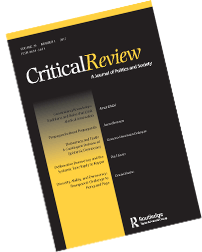
Critical Review, Volume 29 | No. 1
CONSTRAINING KNOWLEDGE: TRADITIONS AND RULES THAT LIMIT MEDICAL INNOVATION
Amar Bhidé
ABSTRACT: Non-medical innovation has become progressively more open, harnessing the enterprise and creativity of a variety of players (including venturesome consumers) and relying on diverse structured and unstructured methods to generate and select advances. Medical innovation, however, remains more closed and regimented because of age-old traditions, reinforced by modern funding and regulatory practices that require the costly ex-ante demonstration of efficacy. These practices, which seek to replicate those of the natural sciences, militate against the pluralistic creation and use of medical innovations and suppress ad-hoc, accretive—and potentially life-saving—advances.
PROPAGANDA ABOUT PROPAGANDA
Jason Brennan
ABSTRACT: Jason Stanley’s How Propaganda Works intends to offer a novel account of what propaganda is, how it works, and what damage it does inside a democratic culture. The book succeeds in showing that, contrary to the stereotype, propaganda need not be false or misleading. However, Stanley offers contradictory definitions of propaganda, and his theory, which is both over- and under-inclusive, is applied in a dismissive, highly ideological way. In the end, it remains unclear how much damage propaganda does. Voters in modern democracies would be ignorant and irrational even without propaganda.
DEMOCRACY AND TRUTH: A CONTINGENT DEFENSE OF EPISTEMIC DEMOCRACY
Gustavo Hessmann Dalaqua
ABSTRACT: Contrary to what some critics of epistemic democracy claim, the association between democracy and truth does not necessarily make the former inhospitable to conflict, contestation, and pluralism. With the help of John Stuart Mill and William James, truth can be interpreted so as to make it compatible with a democratic politics that appreciates conflict and dissent. In some circumstances, truth claims are politically relevant and should become the object of democratic deliberation.
DIVERSITY, ABILITY, AND DEMOCRACY: A NOTE ON THOMPSON’S CHALLENGE TO HONG AND PAGE
Daniel Kuehn
ABSTRACT: The Hong-Page theorem holds that a group of low-ability, cognitively diverse problem solvers can outperform a more uniform group of high-ability problem solvers. Abigail Thompson’s recent mathematical criticisms of the theorem are incorrect, misleading, or irrelevant to the validity of the theorem. A common thread running through Thompson’s objections is a lack of appreciation for how mathematics is used in social science. One element of her critique that has considerable value for the epistemic democracy literature, however, is her discussion of the importance of randomization for the Hong-Page result.
DELIBERATIVE DEMOCRACY AND THE SYSTEMIC TURN: REPLY TO KUYPER
Paul Gunn
ABSTRACT: According to Jonathan Kuyper, deliberative democratic theory, having taken a “systemic turn,” is now better able to deal with the complexity of the real world. Central to this development is the democratic “division of epistemic labor,” under which experts, public servants, and the politically engaged may compensate for the relative ignorance of democratic citizens at large. However, the systemic turn raises the question of whether deliberation has been reconstituted as a means to the end of citizens’ interests, or whether it remains an end in itself. To the extent that deliberation has been accepted as a means to the realization of common interests, the systemic turn begs the question of why we should expect the epistemic division of labor to be effective in identifying public policies that serve those interests. To the extent that deliberative democrats seek to avoid this problem by retaining an a priori commitment to deliberative inclusion, it is more than conceivable that the systemic turn will descend into a simplistic and unedifying form of functionalism.
Econ Journal Watch, Volume 14, Issue 2, May 2017
A king cursed: Kenneth Rogoff’s The Curse of Cash is assayed by Jeffrey Rogers Hummel, and Rogoff responds.
Stationarity problem: Brendan Beare criticizes a Journal of Econometrics article purporting to model a time series of densities as a nonstationary cointegrated process.
Music piracy coda: Stan Liebowitz replies to Felix Oberholzer-Gee and Koleman Strumpf.
Got entrepreneurship yet?: Dan Johansson and Arvid Malm search textbooks and assigned readings at top Econ Ph.D. programs.
New entries extend the Classical Liberalism in Econ, by Country series to 15 articles:
- Xingyuan Feng, Weisen Li, and Evan Osborne findsome history and prospects for classical liberalism in China.
- Hannes Gissurarson traces Iceland’s liberal history from 1840 to 1991.
My Most Regretted Statements, a symposium, contains these contributions:
- Monique Bégin tells of a statement she often repeated in her time as Canada’s Minister of National Health & Welfare: “Canada is the Sweden of the Americas.”
- Michael Boskin reflects on his time as Chairman of the Council of Economic Advisers and the hazards of misattribution, of not controlling op-ed titles, and of equations going missing.
- Tyler Cowen reflects on his circa 2007 underestimation of the likelihood of a major financial crisis.
- Jon Elster draws from his work on defective belief formation, illustrating with his own past errors, including about the electorate binding itself and about thinking of anti-communists “as a clock that is always one hour late rather than as a broken clock that shows the right time twice a day.”
- Richard Epstein tells of his conversion to consequentialism.
- Sam Peltzman relates his hardy forecast in 1988 of Michael Dukakis’s impending victory over George H. W. Bush.
- Cass Sunstein begins: “I have said a lot of things that I regret.” And he ends: “A main job of academics is to float ideas and take risks, and if they do not make mistakes, or learn enough to change their minds, well, that’s really something to regret.”
Access the symposium here.
The Journal of Private Enterprise, Spring 2017, 32 (1)
- Jordan, Jerry L.. 2017. «Hayek in His Own Words.» The Journal of Private Enterprise 32(1) Spring: 1-9.
- Poole, William. 2017. «Hayek on The Road to Serfdom.» The Journal of Private Enterprise32(1) Spring: 11-28.
- Boettke, Peter; Rosolino Candela. 2017. «The Intellectual Context of F. A. Hayek’s The Road to Serfdom.» The Journal of Private Enterprise 32(1) Spring: 29-44.
- Pecquet, Gary M.. 2017. «The Original Road to Serfdom: From Rome to Feudal Europe.»The Journal of Private Enterprise 32(1) Spring: 45-62.
- Thies, Clifford. 2017. «Not So Great Utopias.» The Journal of Private Enterprise 32(1) Spring: 63-76.
- Adhia, Nimish. 2017. «Happiness Economics and Its Discontents.» The Journal of Private Enterprise 32(1) Spring: 77-88.
- Vachris, Michelle Albert; Justin P. Isaacs. 2017. «The Role of Cultural Values in the Formation and Survival of Pro-Growth Institutions.» The Journal of Private Enterprise32(1) Spring: 89-113.
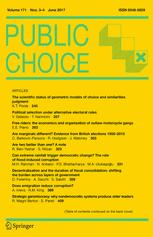
Public Choice, Volume 171, Issue 3-4, June 2017
-
2. Political selection under alternative electoral rules
Pages 257-281
4. Are marginals different? Evidence from British elections 1950–2015
Pages 303-321
6. Can extreme rainfall trigger democratic change? The role of flood-induced corruption
Pages 331-358
7. Decentralization and the duration of fiscal consolidation: shifting the burden across layers of government
Pages 359-387
8. Does emigration reduce corruption?
Pages 389-408
Book Review
10. Cass R. Sunstein: The ethics of influence: government in the age of behavioral science
Pages 429-432
LiberAcción 2017 – Conversación sobre la empresarialidad