Avatar de Desconocido

Acerca de Nicolas Cachanosky

Associate Professor of Economics Director - Center for Free Enterprise The University of Texas at El Paso

EPT: Que le pasa al dolar blue?

Comentario en EPT sobre la cotización del dolar blue (mercado negro) en Argentina. ¿Por qué baja? ¿Cuál debería ser su valor y por qué?

Hace ya algunas semanas que el dólar blue muestra estancamiento o retroceso. Las condiciones económicas del país, sin embargo, no han cambiado. ¿Por qué, entonces, baja el blue?

Es importante distinguir entre movimientos estacionales y la tendencia, y la presencia de ciertas decisiones políticas que pueden afectar la cotización del blue. A esto se suma la dificultad de que al ser un mercado en negro no hay datos certeros de volumen, transacciones, etc.

Seguir leyendo en EPT.


SMP: No, the interest rate is not the price of money

Comentario en el SMP sobre la confusión de que la tasa de interés es el precio del dinero. También con algún insight de donde proviene este error en el sistema keynesiano.

The notion that the interest rate is the price of money is seriously misled. As I move forward with my lectures on the Keynesian system, this is something that I want to make clear to my students. Certainly, when evaluating the Keynesian model, we need to understand what the model says (and what it does not say), but unfortunately, textbooks do not always tackle controversial issues. This is an example of the perpetuation of errors and misconceptions by textbooks. To see this for yourself, simply open a random macroeconomics textbook and read what it has to say about the classical economists– then, open a book actually written by a classical economist and compare what the two have to say.

Seguir leyendo en SMP.

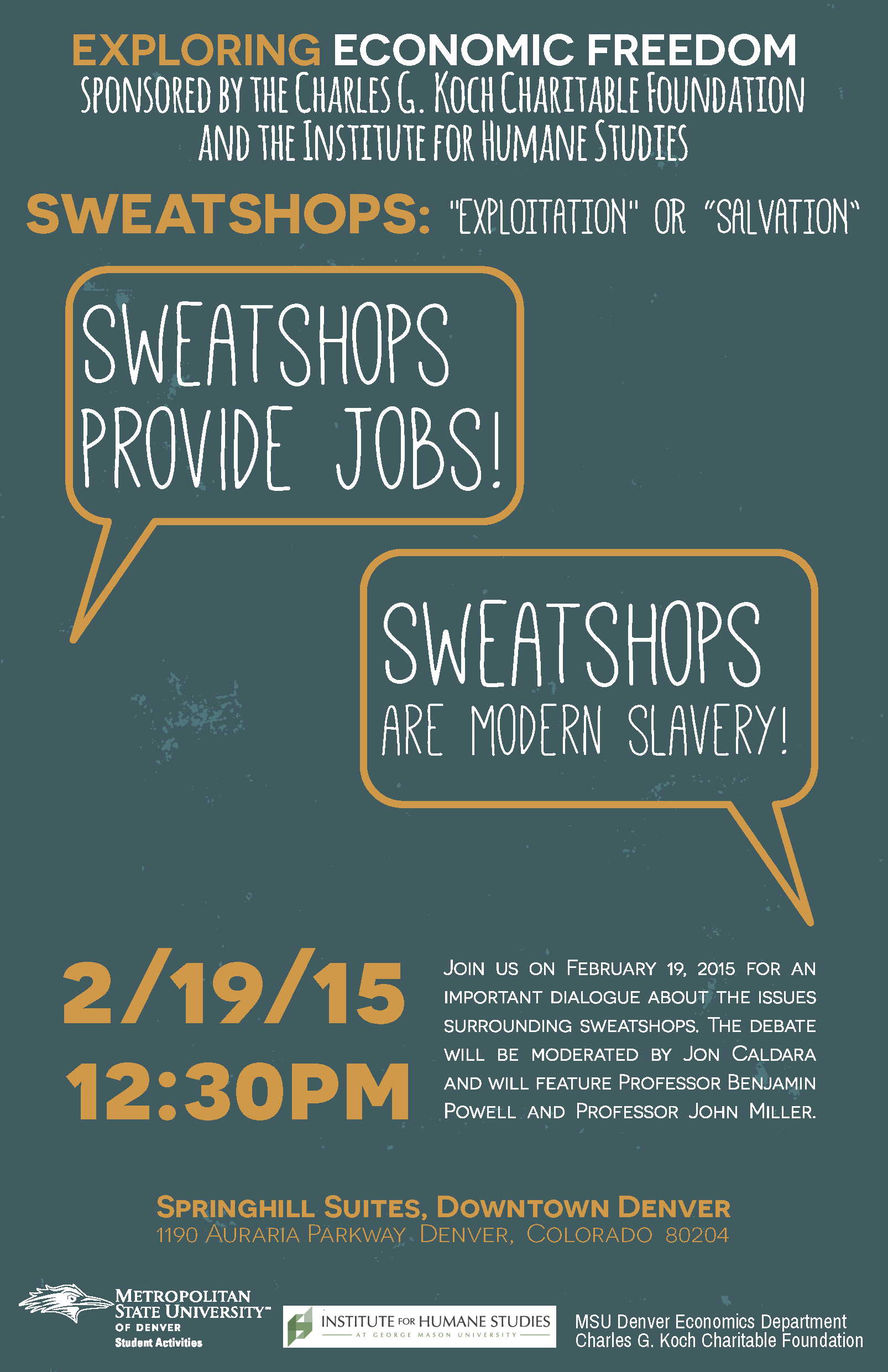
Debate Online en Vivo: Sweatshops, exploitation or salvation?

El Exploring Economic Feedom Project de Metropolitan State University of Denver con el Sponsor del Institute of Human Studies anuncia la transmisión en vivo del debate «Sweatshops: Exploitation or Salvation» el próximo jueves 19 de febrero a las 12.30pm hora local de Denver (16.30 hora de Buenos Aires)

Flyer - Sweatshop Debate

El debate será entre Benjamin Powell (Free Market Institute) y John Miller (Wheaton College) y moderado por Jon Caldara (presidente del Independence Institute). Ambos expositores han tratado en extenso si los sweatshops ayudan a comabir la pobreza extrema o sí sirven para obtener ganancias extraordinarias a expensas de trabajadores en países de bajos ingresos.

El debate será transmitido en vivo por el canal del Exploring Economic Freedo Project en YouTube. Esperamos que puedan verlo y disfruten del evento.

Hayek and Contemporary Macroeconomics (by Larry White)

Larry White comparte un muy interesante borrador sobre la relación e influencia de Hayek en la macroeconomía contemporánea. Es una lectura que vale la pena para todo interesado en ciclos económicos.

Comparto los puntos centrales de la conclusión:

The booms should not just precede but cause the busts: busts are fundamentally endogenous, the result of the vulnerabilities and distortions built up during the boom.

The busts should generate debt and capital stock overhangs – the natural legacy of the preceding unsustainable expansion.

And potential output should not just be identified with non-inflationary output: as the previous evidence indicates, output may be on an unsustainable trajectory even if inflation is stable.

Bajar el paper de SSRN.

Intermediate Macro: Lecture Notes (Aggregate Demand)

Aquí dejo las lecture notes de la demanda agregada en el modelo clásico. Algunos me consultaron sobre el tratamiento de GO (Gross Output) que no aparecian mencionados en la lecture de mediciones macroeconomicas.

En estas notas sí aparece en el contexto de MV = PT vs MV = PY. La relacion es la siguiente:

  • GO = GDP + II (Intermediate Investment)
  • GDE (Gross Domestic Expenditures) = GO + IE (Intermediate expenditures)
  • GDE > GO > GDP

Es decir, GDE es una medición aún más cercana a T que GO.

En este capitulo no me explayo mucho en las implicancias de las diferencias (inversion es mas importante que consumo en GO, que tambien es mas volatil, etc.) Creo que esto va a «calzar» mejor en el tema de política monetaria en el contexto de la Regla de Hayek y NGDP Targeting.

También comparto una planilla excel donde tengo armados modelos que son parte del curso.

Bajar las notas de clase.

Bajar los modelos macroeconomics en Excel.

Bajar las instruciones de la planilla Excel.

Peter Boettke en The Daily Bell: The Transformative Rise of Austrian Economics

The Daily Bell hace llegar una interesante entrevista a Peter Boettke sobre el desarrollo contemporáneo de la Escuela Austriaca. Bettke resume lo sucedido en los últimos años, el programa en GMU y no deja de tocar algunos temas teóricos de interés.

Daily Bell: It’s been quite a while since we last chatted. How is your program at George Mason going?

Peter Boettke: Yes, I believe we last spoke in 2010. GMU’s program has really been doing quite well since that time. We have added some high quality faculty and continue to recruit some very strong graduate students. And our alumni have been doing some outstanding work – both in terms of publishing and in terms of institution building.

Let me give a few examples. Ben Powell and David Skarbek are both doctoral students that I supervised. Ben Powell recently published his book Out of Poverty with Cambridge University Press and it has met with extremely good reviews and praise from his professional peers. Ben has also moved to Texas Tech University, where he has become the Director of the Free Market Institute.

I am a visiting professor there this year, and during my visit in the fall I was amazed at what Ben is accomplishing there with his faculty partners and graduate students. I expect you will hear great things about Ben’s continued success in contributing to the scientific literature in economics and political economy, with his training of graduate students to be the next generation of college and university teachers of economics and the advancement of the ideas of economic and political liberty through his good work. See his new TV show «Free to Exchange» for an example. Just fantastic stuff. A link to his new institute is here.

David Skarbek’s book, The Social Order of the Underworld, was published by Oxford University Press in 2014, and has been discussed in The Economist and The Atlantic. The book – which is based on material that formed his doctoral dissertation – examines the economic and political organization of gangs inside the prison system. Not only has Dave’s work drawn significant attention, it has won major academic awards from his peers.

Seguir leyendo en The Daily Bell.

SMP: Sound money abroad: the Ecuadorian case

Comparto comentario en Sound Money Project sobre la entrevista de Larry White respecto a la dolarización en Ecuador.

Sometimes sound money can be found abroad. Some countries, simply put, cannot or do not want to have reliable monetary institutions. Take the example of Argentina.Since the foundation of the central bank in 1935, the equivalent yearly inflation has been 55%. Venezuela is also experiencing very high inflation.

When sound money cannot be found domestically, often the best place to look is abroad.

Seguir leyendo en SMP.