|
|
|
|
|
|
|
|
|
|
|
|
|
|
|
|
|
|
|
|
|
|
|
|
|
|
|
||||||||||
|
||||||||||
|
||||||||||
|
||||||||||
| Acceda aquí al ejemplar completo. |
Pierre Desrochers, Vincent Geloso: Snatching the Wrong Conclusions from the Jaws of Defeat: Part 1 – The Missing History of Thought: Depletionism vs Resourceship
Pierre Desrochers, Vincent Geloso: Snatching the Wrong Conclusions from the Jaws of Defeat: Part 2 – The Wager: Protagonists and Lessons
Nikolai G. Wenzel: Classical Communitarianism and Liberal Anomie: Toward an Individual yet Robust Theory of Citizenship
Youliy Ninov: A Free Market Alternative to Anarcho-Capitalism
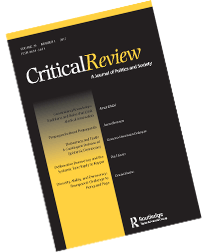
CONSTRAINING KNOWLEDGE: TRADITIONS AND RULES THAT LIMIT MEDICAL INNOVATION
Amar Bhidé
ABSTRACT: Non-medical innovation has become progressively more open, harnessing the enterprise and creativity of a variety of players (including venturesome consumers) and relying on diverse structured and unstructured methods to generate and select advances. Medical innovation, however, remains more closed and regimented because of age-old traditions, reinforced by modern funding and regulatory practices that require the costly ex-ante demonstration of efficacy. These practices, which seek to replicate those of the natural sciences, militate against the pluralistic creation and use of medical innovations and suppress ad-hoc, accretive—and potentially life-saving—advances.
PROPAGANDA ABOUT PROPAGANDA
Jason Brennan
ABSTRACT: Jason Stanley’s How Propaganda Works intends to offer a novel account of what propaganda is, how it works, and what damage it does inside a democratic culture. The book succeeds in showing that, contrary to the stereotype, propaganda need not be false or misleading. However, Stanley offers contradictory definitions of propaganda, and his theory, which is both over- and under-inclusive, is applied in a dismissive, highly ideological way. In the end, it remains unclear how much damage propaganda does. Voters in modern democracies would be ignorant and irrational even without propaganda.
DEMOCRACY AND TRUTH: A CONTINGENT DEFENSE OF EPISTEMIC DEMOCRACY
Gustavo Hessmann Dalaqua
ABSTRACT: Contrary to what some critics of epistemic democracy claim, the association between democracy and truth does not necessarily make the former inhospitable to conflict, contestation, and pluralism. With the help of John Stuart Mill and William James, truth can be interpreted so as to make it compatible with a democratic politics that appreciates conflict and dissent. In some circumstances, truth claims are politically relevant and should become the object of democratic deliberation.
DIVERSITY, ABILITY, AND DEMOCRACY: A NOTE ON THOMPSON’S CHALLENGE TO HONG AND PAGE
Daniel Kuehn
ABSTRACT: The Hong-Page theorem holds that a group of low-ability, cognitively diverse problem solvers can outperform a more uniform group of high-ability problem solvers. Abigail Thompson’s recent mathematical criticisms of the theorem are incorrect, misleading, or irrelevant to the validity of the theorem. A common thread running through Thompson’s objections is a lack of appreciation for how mathematics is used in social science. One element of her critique that has considerable value for the epistemic democracy literature, however, is her discussion of the importance of randomization for the Hong-Page result.
DELIBERATIVE DEMOCRACY AND THE SYSTEMIC TURN: REPLY TO KUYPER
Paul Gunn
ABSTRACT: According to Jonathan Kuyper, deliberative democratic theory, having taken a “systemic turn,” is now better able to deal with the complexity of the real world. Central to this development is the democratic “division of epistemic labor,” under which experts, public servants, and the politically engaged may compensate for the relative ignorance of democratic citizens at large. However, the systemic turn raises the question of whether deliberation has been reconstituted as a means to the end of citizens’ interests, or whether it remains an end in itself. To the extent that deliberation has been accepted as a means to the realization of common interests, the systemic turn begs the question of why we should expect the epistemic division of labor to be effective in identifying public policies that serve those interests. To the extent that deliberative democrats seek to avoid this problem by retaining an a priori commitment to deliberative inclusion, it is more than conceivable that the systemic turn will descend into a simplistic and unedifying form of functionalism.
A king cursed: Kenneth Rogoff’s The Curse of Cash is assayed by Jeffrey Rogers Hummel, and Rogoff responds.
Stationarity problem: Brendan Beare criticizes a Journal of Econometrics article purporting to model a time series of densities as a nonstationary cointegrated process.
Music piracy coda: Stan Liebowitz replies to Felix Oberholzer-Gee and Koleman Strumpf.
Got entrepreneurship yet?: Dan Johansson and Arvid Malm search textbooks and assigned readings at top Econ Ph.D. programs.
New entries extend the Classical Liberalism in Econ, by Country series to 15 articles:
My Most Regretted Statements, a symposium, contains these contributions:
Access the symposium here.
Pages 257-281
Pages 303-321
Pages 331-358
Pages 359-387
Pages 389-408
Book Review
Pages 429-432
Editorial —Carrie-Ann Biondi and Shawn Klein
Symposium: Andrew Jason Cohen’s Toleration
Comments on Andrew Jason Cohen’s Toleration
—Emily M. Crookston – 8 Comments on Andrew Jason Cohen’s Toleration —David Kelley
Response to Emily M. Crookston and David Kelley
—Andrew Jason Cohen
Articles
Freedom: Positive, Negative, Expressive —Danny Frederick 39 Memorializing Genocide I: Earlier Holocaust Documentaries
—Gary James Jason
Review Essays
The U.S. Founding: Washington’s Allies and Opponents: Review Essay of John Ferling’s Jefferson and Hamilton, Stephen Knott and Tony Williams’s Washington and Hamilton, Thomas Fleming’s The Great Divide, and Carson Holloway’s Hamilton versus Jefferson in the Washington Administration
—Richard M. Salsman 89 Review Essay: The Politics of Defeat: A Tribute to Sadik al-Azm’s Self-
Criticism after the Defeat —Kanan Makiya 100 Review Essay: Timur Kuran’s The Long Divergence: How Islamic Law Held Back the Middle East —Salim Rashid 117
Acceda aquí al ejemplar en pdf completo.
Book Review
 Punto de Vista Economico