En el día de ayer se publicaron los datos oficiales de inflación del mes de junio, completando así el panorama inflación a mitad de año. A continuación tres gráficos de inflación. Luego unos breves comentarios.
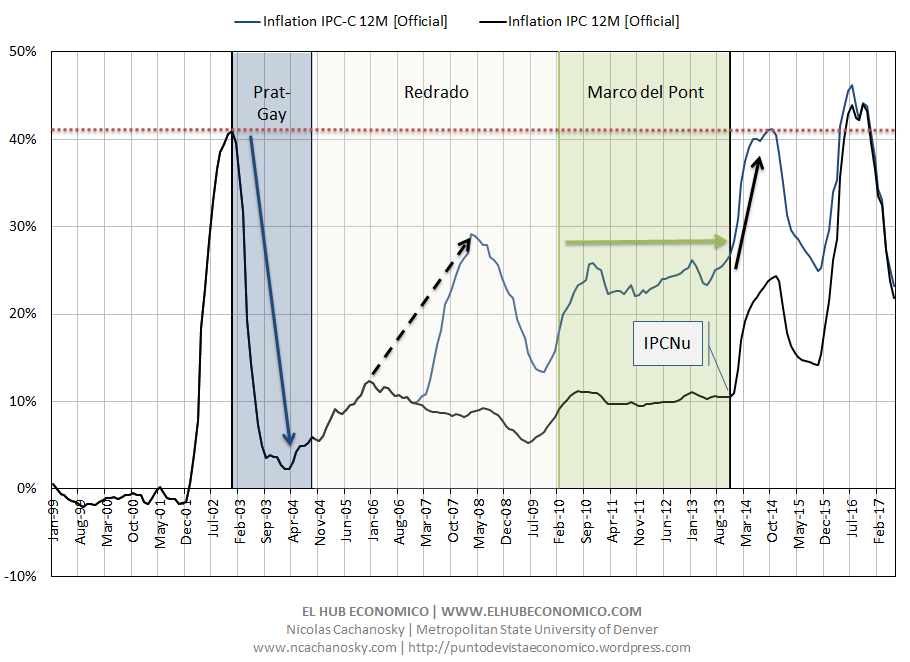

En el día de ayer se publicaron los datos oficiales de inflación del mes de junio, completando así el panorama inflación a mitad de año. A continuación tres gráficos de inflación. Luego unos breves comentarios.
Mi último post en SMP sobe las anteojeras de la política monetaria.
I just read Ben Bernanke’s “The Federal Reserve and the Financial Crisis.” The book was actually published in 2013, and it contains his 2012 lectures at George Washington University. It contains four well written lectures that cover the history of the U.S. Federal Reserve and the 2008 financial crisis. Some of the complexities of the 2008 are clearly exposed.
However, what called my attention was the strength that monetary policy and theory blinders can have. Some of the blinder’s effects are not new. One example: to depict the gold standard as a system that fixes the price of gold and consists of an international fixed exchange rate regime. This is very common misrepresentation of the gold standard. First, in this monetary regime gold, not the dollar, is money. The dollar, as a convertible banknote is a gold sustitute. Therefore there is no fixing of the price of gold. This is similar to arguing that writing a check is fixing the price of the dollar. For a similar reason there is no fixed exchange rates. This is to confuse what is money and what is a substitute under gold standard. All countries in the gold standard network use the same currency, gold. There is no pegging of the exchange rate in gold standard just as there is no pegging of the Euro in the Euro area. Different would be the case of fixing the exchange rate between gold and silver (two different currencies.) Using again the check example, to argue that the gold exchange means an international fixed exchange rate regime is like arguing that there is a fixed exchange rate between two checks convertible to dollars that were issued by different banks. This is to confuse a price (exchange rate) with a parity or conversion relation.
Vincent Geloso responde a mi post en Notes on Liberty sobre el ingreso de salarios mínimos. El punto de él es interesante, aunque creo que cae al margen de mi argumento. Mi corta respuesta en NOL
A few days ago I posted here at NOL a short comment on some reaction I’ve seen with regards to Seattle’s minimum wage study. Vincent Geloso offers an insightful criticism of my argument. Even if his point is quite specific (or so it seems to me), it offers an opportunity for some clarification.
But first, what was my argument? My comment was aimed at a specific point raised by advocates of increasing minimum wages. Namely, that even if Seattle’s study shows an increase in unemployment, a study with a larger sample may say otherwise. My point is that the way I’ve seen this criticism raised is missing the economic insight of minimum wage analysis, namely that jobs will be lost in less efficient employers and employees first. So far so good. The problem Geloso points out is with my example. I refer to McDonald’s as the efficient employers fast food chain (think of economics of scale) and as less efficient employers the neighborhood family-run little food place (neighborhood’s diner).
El último video de la Fundación Libertad y Progreso sobre un sentimiento demasiado extendido en la Argentina K, y también en las post-K (al menos hasta ahora).
Debajo el video… con la participación estelar de una «Cacha»
El problema de los salarios mínimos está muy presente en la opinión pública americana. Aquí unas segundas reflexiones para Notes on Liberty sobre dónde buscar (y no buscarl) los efectos producidos por este tipo de precio regulado.
A recent study on the effect of minimum wages in the city of Seattle has produced some conflicted reactions. As most economists expected, the significant increase in the minimum wage resulted in job losses and bankruptcies. Others, however, doubt the validity of the results given that the sample may be incomplete.
In this post I want to focus just one empirical problem. An incomplete sample in itself may not be a problem. The issue is whether or not the observations missing from the sample are relevant. This problem has been pointed out before as the Russia Roulette Effect, which consists in asking survivors of the increase in minimum wages if the increase in minimum wages have put them out of business. Of course, the answer is no. In regards to Seattle, a concern might be that fast food chains such as McDonald’s are not properly included in the study.
Comentario en SMP sobre qué tan compatible es el Efecto Cantillon con la neutralidad del dinero.
Money neutrality is a key principle in monetary economics. As might seem obvious, the amount of goods that can be produced depends on the availability of factors of production (such as capital and labor) and on technological knowledge. For instance, the fact that more dollars are in circulation does not mean we can produce more tables and chairs. But if we have better technology, more labor, or more wood, then we can produce more tables and chairs.
On the other hand, Cantillon Effects are equally plausible. The Cantillon Effect refers to the change in relative prices resulting from a change in money supply. The change in relative prices occurs because the change in money supply has a specific injection point and therefore a specific flow path through the economy. The first recipient of the new supply of money is in the convenient position of being able to spend extra dollars before prices have increased. But whoever is last in line receives his share of new dollars after prices have increased. This is why when the Treasury’s deficit is monetized, inflation is referred to as a non-legislated tax. In these cases, the government has seized purchasing power (rather than physical bills) from its citizens without congressional approval.
Reflexiones, críticas, sobre la inacción de Cambiemos respecto a los problemas económicos de fondo.
Hace alrededor de 70 años que Argentina vive de crisis en crisis, tanto económicas como políticas. Ningún gobierno hasta el momento se ha abocado a llevar adelante las reformas estructurales necesarias para generar un punto de inflexión en la economía argentina. Por el contrario, cada gobierno se ha dedicado más a hacer equilibrio en los períodos entre crisis que a prestarle atención a las soluciones de fondo. Lamentablemente, hasta el momento Cambiemos no es la excepción.
Es probable que en los próximos meses se comience a discutir si se debe o no reducir el balance de la Reserva Federal. Un breve comentario al respecto para Sound Money Project.
It seems likely that in the coming months monetary policy discussion will start focusing on the problem of shrinking the Fed’s balance sheet. A particular challenge of shrinking the Fed’s balance sheet is that of discontinuing the policy of paying interest on reserves (IOR). While at first sight it might seem that the IOR is too low to have any significance, it indeed has an effect on the demand for reserves by the banks (for an interesting discussion see here.) The policy of IOR increases the demand for reserves, while shrinking the balance sheet would reduce the supply of reserves.
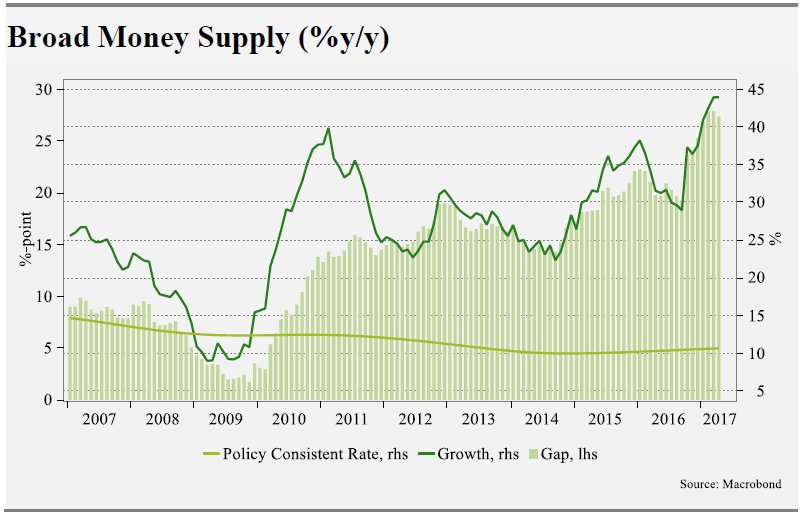
El Global Monetary Condition Report Monitor publica Lars Christensen a través del Markets & Money Advisory acaba de agregar a Argentina a su cobertura económica a partir del mes de mayo. De este modo Argentina se suma al análisis monetario de países como China, Japón, Suiza, República Checa y la zona Euro entre otras áreas monetarias.
En este post del glob de Markets & Money Advisorry se introduce el caso de Argentina. En su primer reporte se mencionan las dificultades que presenta el desequilibrio fiscal que el gobierno de Macri aún no ha dominado.
 A modo de ejemplo, el siguiente gráfico del reporte de mayo sugiere que la política monetaria no estaría siendo consistente con las metas de inflación.
Paper con Alexandre Padilla donde estudiamos cuál es el impacto (si es que lo hay) de los extranjeros en Estados Unidos. Sucede, como sostiene Borjas, que los inmigrantes traen consigo «malas» institutiones que pueden dañar el desempeño económico y social del país anfitrion?
Concerns about the institutional impact of immigration, particularly, in the United States, are not new. We can trace them all the way back to Thomas Jefferson and Alexander Hamilton. More recently, in response to a literature that questions the efficiency of current immigration restrictions, Borjas (2015) expresses similar concerns about the institutional impact of immigrants coming from countries with poor institutions. Using economic freedom as proxy for institutional quality of the American states since 1980, using several estimation techniques and control variables, our results show that concerns about the institutional impact of immigrants are so far not supported.
 Punto de Vista Economico